
Newsletter 2020 Summer
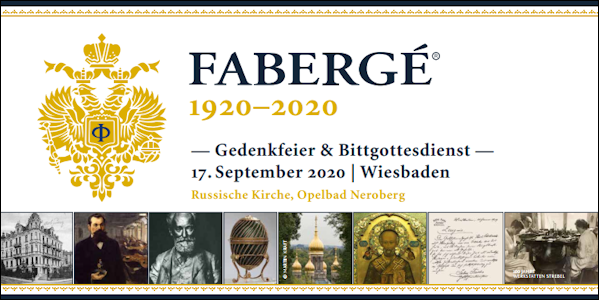
Memorial Event Dedicated to the 100th Anniversary of the Death of Carl Fabergé (1846-1920)
September 17, 2020 – Russian Orthodox Church of Saint Elizabeth on the Neroberg in Wiesbaden (Germany)
Program Notes (in German)
RSVP to Horst Becker, participation is limited to 80-100 guests
On September 24, 2020, the actual the 100th anniversary date of Fabergé’s death. “Fabergé-Panel Pully” will be presented to the Foundation La Rambarde, Pully La Rosiaz, Switzerland (former Hotel Bellevue where the Russian jeweler Fabergé spent his last days).
Dr. Marina Lopato, dedicated Fabergé curator and scholar at the Hermitage Museum in St. Petersburg, Russia, died on July 27, 2020.

Fabergé Venue at the General Staff Building
(Photograph Viktoria Petrova, Hermitage Museum)
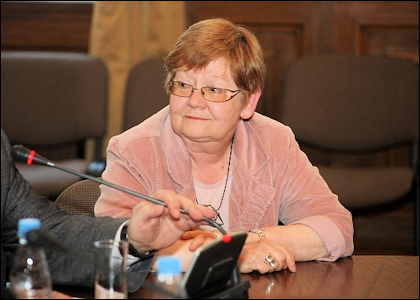
St. Petersburg, Russia
(Photograph Galina Korneva)
It was my pleasure to become acquainted with Marina Lopato in the 1990’s when she whole-heartedly supported the goals of the Fabergé Arts Foundation (FAF) headquartered in Washington (DC) to promote curatorial exchanges between countries and prepare traveling Fabergé exhibitions. A quote in the classic 1993 monograph, Fabergé: Imperial Jeweler, which Lopato co-authored with Géza von Habsburg, accompanied the exhibition of close to 400 objects traveling from St. Petersburg to Paris and London:
The most recent accomplishment of Marina Lopato is on view permanently in St. Petersburg, Russia, in the General Staff Building (rooms #301–302). A virtual tour of the Fabergé Collection belonging to the State Hermitage Museum pays tribute to her dedication of studying and interpreting Fabergé’s art for generations. (Christel McCanless)
Did Fabergé ever make duplicates? The answer to this question is yes, in a way. It is rare to find exact duplicates, yet one finds variations on a theme. In other words, two pieces may be identical in style or shape, but vary in enamel color and type of gemstone used, or have an added decorative applique. Beginning with a uniform mold the Fabergé firm used a production line process1 to make the body of a cigarette case using standard styles, and shapes. Upon completion the cases went to the engraving department. In his memoirs, Jalmari Haikonen (1896-1989), a young journeyman engraver in the Wigström workshop, states in 1916: “We could have as many as 40 cases lined up waiting to be engraved or otherwise worked.”2 After the stamping and engraving was completed, they were enameled and as a final touch, an applique applied on the cover. A dozen extant cigarette cases with a sunburst pattern from two workshops have been identified:
- August Holmström (workmaster mark AH
 , active 1857-1903), and
 - August Hollming (workmaster mark A*H
 , active 1880-1913).
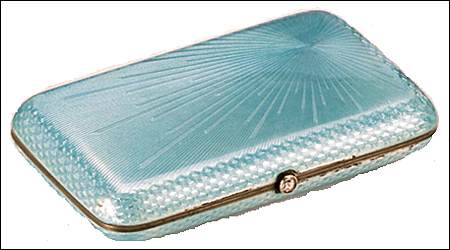
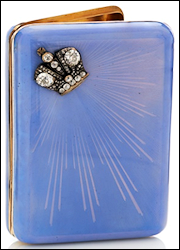
(B.) Enamel and Silver-gilt Lady’s Cigarette Case, Workmaster August Hollming, St. Petersburg, Russia, 1899-1908, Size: 8 cm (Sotheby’s Geneva, November 17, 1998, Lot 409; Sotheby’s London, December 1, 2005, Lot 345)
(C.) Enamel Gold Cigarette Case, Diamond-set Crown, August Holmström, St. Petersburg, 1896-1908, Size: 9.6 cm (Danish Royal Collection; Koldinghus (Denmark) Museum Exhibition Catalog, Faberge – Tsar’s Court Jeweler and His Association to the Danish Royal Family, 2016, pp. 40, 85)
Provenance: Presented to Crown Prince Frederik, who represented King Christian IX at the Tsar’s [Nicholas II] Coronation in Moscow on May 26, 1896.
The study focuses on cases (3-4 in., 8-9.6 cm in height) with one pattern repeated over and over again to illustrate variations on almost identical cases in size. The sunburst pattern (A.) radiating from the upper left corner of a case with varying lengths of rays, and a basket weave border is made with a guilloché engraving machine, a mechanical device which uses a sharp tool to engrave identical and repetitive designs on a metal surface3 before enameling. Decorations are added to make each one unique and different from the rest. The plain enameled pale blue case (B.) from the August Hollming workshop has no applied decoration, so the sunburst pattern and the basket weave border engravings complete with a diamond thumb piece shows its true beauty. The interiors of all silver cases have a gold-gilt (a gold wash) which keeps the silver from tarnishing and soiling the cigarettes.
For Imperial presentation cigarette cases decorations in gold, silver, or platinum were added to the cases’ covers. The earliest example found so far with a diamond-set crown at the center of the sunburst is an Imperial presentation case from the August Holmström (C.) studio. Presented to Crown Prince Frederik VIII at the coronation of Nicholas II in 1896, it is solid gold, because of the recipient’s importance. Fabergé’s production line must have been in high gear the year before the Russian coronation to keep up with all the gifts the Imperial Cabinet authorized and presented, or Nicholas II personally presented to dignitaries on this auspicious occasion. Other Russian Imperial presentation gifts are distinguished with an insignia, i.e., the double-headed Eagle, the Imperial Crown, the Emperor’s diamond cypher, or a miniature portrait.
 , active 1857-1903)
Imperial Presentation Cigarette Cases with Eagles
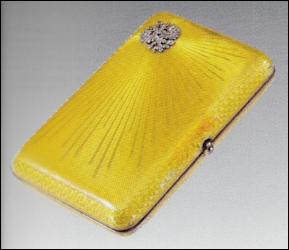
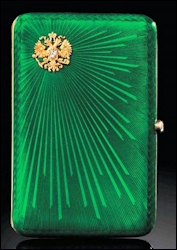
Provenance: Stock number 1189.
(E.) Enamel and Silver-gilt Cigarette Case, Gold Imperial Eagle Centered with a Diamond, August Holmström, St. Petersburg, 1899-1904 (Christie’s, London, November 25, 2013, Lot 238)
Provenance: Presented to Captain John Nicholas, M.V.O., R.H.A., appointed to Superintendent at the Royal Mews, Buckingham Palace in 1901.
Cigarette Cases
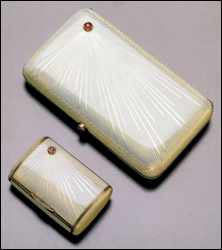
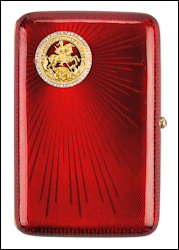

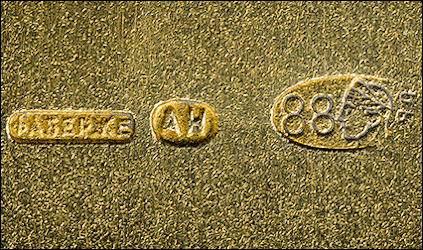
Provenance: Unknown, Case and Box Inventory Numbers – Case /R/2/529, Match Box 529/2 are not typical Fabergé stock numbers.
(G.) Enamel and Silver-gilt, Cigarette Case, Medallion Showing St. George Slaying the Dragon within a Diamond-set Bezel, Sunburst Guilloché Pattern on the Back of the Case, and August Holmström Mark, ca. 1900 (Sotheby’s, New York, October 23, 2003, Lot 64; the Ruzhnikov website has stunning close-ups of the objects suggesting the workmaster was Albert Holmström [son of workmaster August Holmström, who took over the workshop in 1903 after his father’s death, applied for and was granted the same workmaster mark], 1903-1908).
 , active 1880-1913)
Imperial Presentation Cigarette Cases with Eagles and Monogram
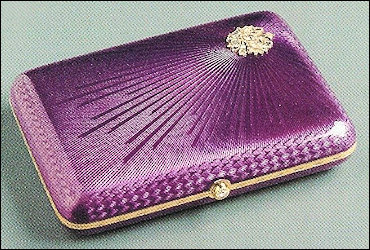
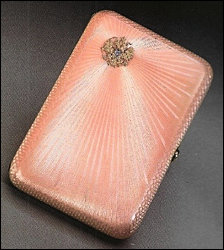
Provenance: Unknown.
(I.) Enamel and Silver-gilt Cigarette Case, Gold Imperial Eagle Centered with a Diamond, August Hollming, 1896-1908, Original Fitted Case (Traina, John, 1998, p. 62)
Provenance: Presented by the Imperial Cabinet on behalf of Emperor Nicholas II to Eduard Vella in May 1902 for services rendered at the Russian consulate in Malta. Stock number 4984.
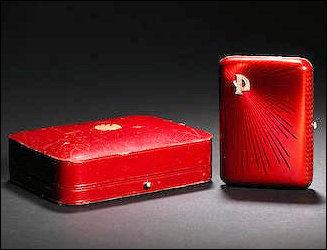
(J.) Enamel and Silver-gilt Cigarette Case, Initial “P” with Single-cut Diamonds, August Hollming, 1899-1908, Original Fitted Leather Case with a Gold Imperial Eagle Imprint (Bonhams, London, May 30, 2012, Lot 205 sold with supporting documentation. The two documents [left in Russian and right in German] are somewhat illegible in the hard copy auction catalog, and are not shown on the Internet. The Russian one appears to relate to the Order of St. Anne (?), dated either June or July 24, 1908. Is it possibly a formal thank you to Nicholas II for awarding the order, while the German text is dated a year later [June 1, 1909] suggesting an Austrian order of the Iron Cross, 3rd class, was presented to the recipient? More research is needed.)
Provenance: Presented by Nicholas II to Don Jose Pulido after awarding him the Cross of St. Anne. The Spanish Aide to the Infant Don Fernando of Spain visited Russia in June 1908.
After 1900, the workmasters’ studios were all in close proximity of each other in the four-story Fabergé building at 24 Bolshaya Morskaya Street in St. Petersburg, Russia. Open doors between the studios facilitated the flow of communication as work on commissions and the steady production of regular stock for the firm’s main shops in St. Petersburg and London progressed. Scholars have assumed the workshops worked independently, and specialized in just certain types of items. For the most part this appears to be true, however, a cross-over design from the Wigström studio (active 1903-1917) to August Hollming (active 1880-1913) has been found, or did the reverse possibly occur? If Wigström had too many cigarette cases pilling up for completion, did he transfer some existing orders to Hollming to meet demands during a time when smoking was very popular in Russia? So far it is a detail yet to be solved.
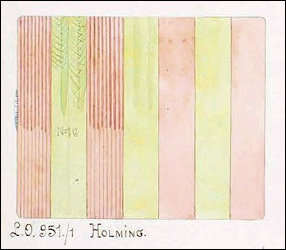
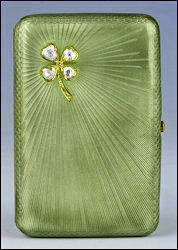
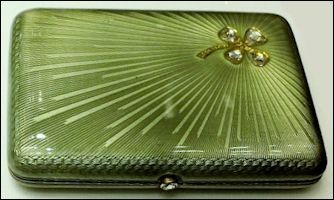
The identification of Faberge hallmarks causes a conundrum, especially with the similarity of the hallmark stamps of August Holmström (AH , active 1857-1903), and August Hollming (A*H , active 1880-1913). The star and sometimes a dot between the two initials of Hollming’s name is a puzzle not yet solved (more details in Conundrum II). Two cigarette cases with an identical guilloché engraving pattern, and very similar diamond four-leaf clover applications in sage green (L.) and the other in pink (M.) enamel are known from the Fabergé collection in the Russian Faberge Museum in St. Petersburg, and the American McFerrin Foundation Collection on view at the Houston Museum of Natural Science in Texas. Géza von Habsburg in his 2000 Wilmington exhibition monograph discusses at some length his hypothesis, namely the separation of responsibilities between workshops and he states an exception, “Holmström’s Imperial presentation cigarette cases are remarkably similar to those produced by the Hollming workshop, to the point that they seem to be interchangeable.” Ulla Tillander-Godenhielm, who has written extensively about the inner workings of the Faberge studios suggests as demand for objects increased in one studio they were sent to another studio for completion. Is it possible the next two identical cases decorated with “four-leaf clovers for good luck” are a case in point as suggested by Tillander-Godenhielm? In the Fabergé literature both cases (L.) and (M.) are interchangeably credited to the Holmström and the Hollming studios.
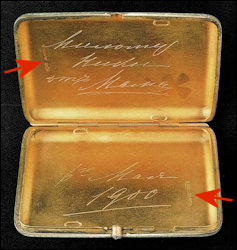
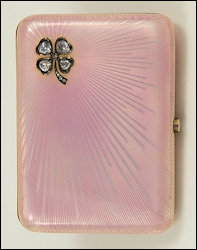
Provenance: “For Dearest Nicky, from Mom. 6 May 1900”, Gift from His Mother, Dowager Empress Maria Feodorovna, for Emperor Nicholas II’s 32nd Birthday
(M.) Pink Enamel and Silver-gilt Cigarette Case, Diamond Clover Leaf, ca. 1900 (From a Snowflake to an Iceberg: The McFerrin Collection, 2013, p. 58; Sotheby’s New York, April 17, 2012, Lot 330)
Provenance: Mrs. Walter Matthau, wife of actor Walter Matthau.
Sage Green Case (L.) has a fascinating history shared during a 2014 tour of the Fabergé Museum collection:
Conundrum I.
What mark does the Fabergé Museum cigarette case (L.) have?
Emperor Nicholas II
(Photograph Christel McCanless)
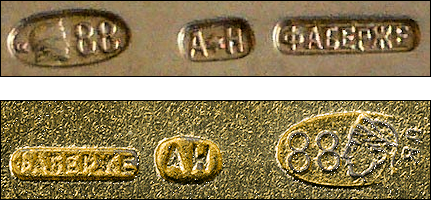
a Sunburst Pattern Case (Russian-Antique.com) by August Holmström Mark
(C. above in this essay)
Traina text suggests the gray-green color (later called sage-green) of the case was the color of the Preobrajensky Regiment, to which he [Nicholas II] belonged, had been founded by Peter the Great, and was the most prestigious. (Wikipedia states the regiment’s color was “predominantly of a dark green, eventually verging on black.”)
On the Russian Fabergé Museum website, the gift is incorrectly tied to the Name Day (December 6th) of Nicholas II.
Conundrum II.
Did August Hollming make the (M.) McFerrin case? What is the difference between the star and the dot on the mark?
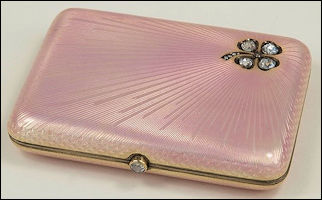
Diamond Clover Leaf, ca. 1900
(McFerrin Foundation Collection, From a Snowflake
to an Iceberg, 2013, p. 58; Sotheby’s New
York, April 17, 2012, Lot 330)
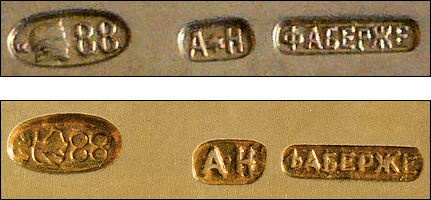
Hollming Hallmark with a Dot and
Not the Usual Star on the McFerrin Cigarette Case
(Sotheby’s New York, April 17, 2012, Lot 330)
McFerrin text: “Albert Holmström or August Hollming” (From a Snowflake to an Iceberg: The McFerrin Collection, 2013, p. 58).
Albert Holmström applied for his late father’s mark in 1903, and used it until 1917 when the Fabergé firm closed.
Other objects (Atzbach | Ruzhnikov | Bonhams) with the
 Hodges, 2009, pp. 60-61
At press time a cigarette case (O.) similar to the sunburst pattern by the August Hollming studio surfaced. Discrepancies in the inscription and the scratched stock number stated for the same case by two different sellers, a dealer and an auction house, intrigued the study team. It was decided this topic of variations be continued in a future issue of the Fabergé Research Newsletter. To share your observations on the two conundrums (I. – II.) yet to be solved from this essay, and other discrepancies below, readers may contact: Tim Adams
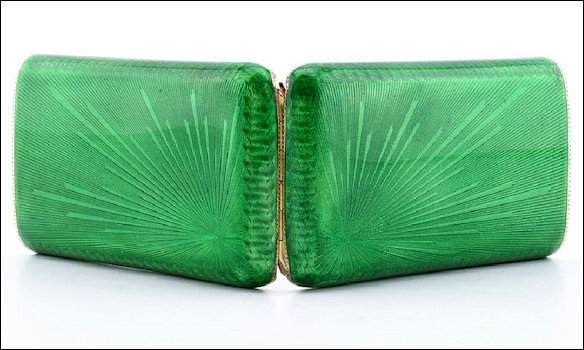
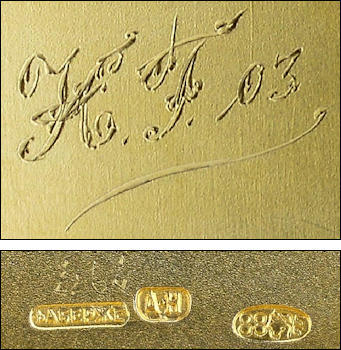
Auction house in 2019: A FABERGÉ SILVER-GILT AND GUILLOCHÉ ENAMEL CIGARETTE CASE, WORKMASTER AUGUST HOLLMING, ST PETERSBURG, 1899-1903, rounded rectangular form, enameled in translucent vivid green over a sunburst engine-turned ground, the interior engraved K.F. oz (sic, oz is an abbreviation for ounces in English, more likely a date ending with 03), struck inside with the workmaster’s initials, Fabergé in Cyrillic, 88 standard, scratched inventory number 9917; with leather case. Length 3 in. (7.7cm)
Great care has to be taken when examining Fabergé hallmark stamps as well as object descriptions, because it is easy to make mistakes which are repeated in publications, and on webpages over and over again. The workshops of Holmström and Hollming were prolific in creating enameled cigarette cases. Using standard molded and engraved cases facilitated the production process. Fortunately, the hundreds of extant cigarette cases for a high demand market never feel mass-produced. With obvious similarities and the unique variations on a theme today’s collectors and researchers can admire the exquisite variations they are.
| 1 | Tillander-Goldenhielm, Ulla. Golden Years of Fabergé, Drawings and Objects from the Wigström Workshop, 2000, pp. 33-34, discusses the production methods. |
| 2 | Tillander-Godenhielm, Ulla. Fabergé: His Master Artisans, 2018, p. 97. |
| 3 | A brief visual introduction to guilloché. Fabergé Research Newsletter, Fall and Winter 2018 |
| 4 | Adams, Timothy. “Fabergé Design Sketches and What They Teach Us”, Fabergé Research Newsletter, Fall and Winter 2018. |
| 5 | Fabergé Research Newsletter, Fall 2014 |
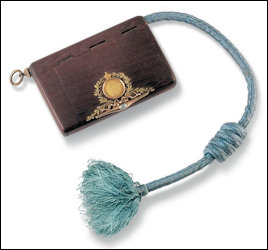
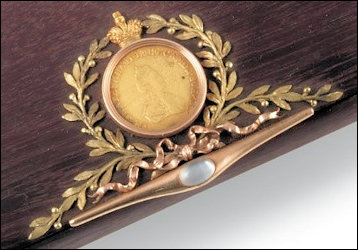
Provenance: Gloria, Property from the late Dowager Countess Bathurst (1927-2018), Stock Number 8673.
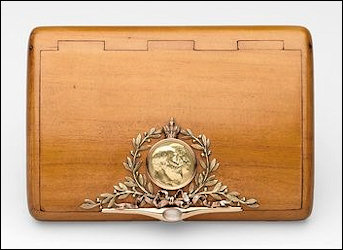
(B.) Cigarette Case, Birch Wood, Marked Fabergé, 1896-1908 (Royal Collection Trust)
Provenance: Presumably acquired by King Edward VII; given to King George V by Queen Alexandra.
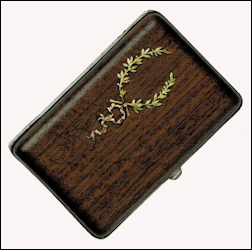
While perusing the catalog for the auction (Christie’s London, July 22, 2020) devoted to the effects of the late Gloria, Dowager Countess of Bathurst (1927-2018), my eye was drawn to a Lot 92: Fabergé wooden cigarette case and enameled buttons, and a Russian wood and enameled bell push. The cigarette case under the hammer (A.) reminded me of a very similar birch wood cigarette case (B.) in the British Royal Collection of Queen Elizabeth II. Its laurel wreath decoration and a coin surmounted by a crown with gold clasp set with a cabochon moonstone appeared similar in design. Yet on closer inspection the royal case did not have a tinder cord to light cigarettes and cigars, and what I thought was a gold coin turned out to be a gold medallion depicting King Edward VII of England and his spouse, Queen Alexandra. The 1902 medallion commemorates the coronation of King Edward scheduled for June 26 of that year, but postponed to August 9, 1902, due to an appendix attack suffered by the king.
The British Royal Collection case (3.5 x 2.2 in.) was “presumably acquired by King Edward VII; given to King George V by Queen Alexandra”2, and probably sold from the London Fabergé shop managed by Allan Bowe3 in 1903 or 1904. The shop opened in September 1903 and Bowe operated it until June/July of 1906. Géza von Habsburg first published information on the London Sales Ledgers4 documenting items sold from 1907-1917, unfortunately no sales records have survived for the years 1903-1906.
The Bathurst cigarette case at auction made from palisander wood with a blue tinder cord has one other difference. Instead of a medallion of Edward VII and Alexandra this case has an 18th century gold coin depicting the Russian Empress Catherine the Great (1729-1796, reigned from 1762-1796). Upon a closer inspection the crowns on the two cases resemble the Russian Imperial crown, while the Royal Collection piece does not have a British crown of St. Edward. My suspicion is the royal case originally held an 18th century Russian ruble. Perhaps it was replaced with the British royal medallion at the request of the purchaser (presumably King Edward VII) when it was purchased ca. 1903-1904. The scratched stock number 8673 on the palisander case suggests a Fabergé production date of 1903.
Viktor Aarne Cigarette Cases
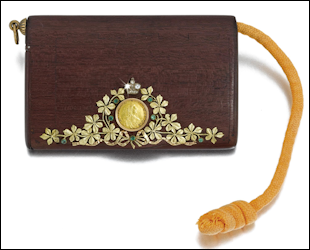
Provenance: Grand Duchess Maria Pavlovna of Russia (1854-1920), now on view in the McFerrin Gallery, Houston Museum of Natural Science in Texas.
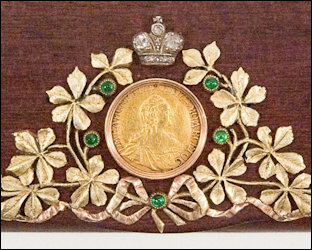
(D.) Cigarette Case, Palisander Wood, Viktor Aarne, Marked on Inner Rim and Wreath, 1896-1908 (Christie’s London, June 9, 2009, Lot 199)
Provenance: Stock Number 8674
The McFerrin case (C.), very similar in design to the Bathurst case (A.) was originally in the collection of Grand Duchess Maria Pavlovna of Russia (1854-1920), the wife of Grand Duke Vladimir Alexandrovich (1847-1909), the son of Emperor Alexander II and uncle of Nicholas II. The case has the distinction along with several other Faberge objects of belonging to the grand-ducal couple and going directly in a span of 91 years from the original owner to the current owners, Dorothy and the late Artie McFerrin. Rather unique in the history of Faberge objects!6
The McFerrin cigarette case (C.):
- Has a tinder cord and is topped by a gold diamond-set crown with a gold Russian ruble depicting Empress Elizabeth Petrovna (1709-1762, reigned 1741-1762), and not Empress Catherine the Great (1729-1796, reigned from 1762-1796).
- Lacks the gold and moonstone thumbpiece, and a stock number.
- The extra elegance and luxury exuding from the gold leaves and the emeralds reflect the taste of its Imperial owners whose court rivaled the extravagance of Emperor Nicholas II’s court.
- The workmaster is Viktor Aarne (J.V.A and BA
 , active 1890-1904).
 , active 1890-1904).
It is likely the two unmarked wooden cigarette cases (A. and B.) similar in design and workmanship, and made in 1900-1904, may also come from the Aarne workshop, or Aarne’s successor workshop, Hjalmar Armfelt (ЯА  , active 1904-1917).
Hjalmar Armfelt Cigarette Case
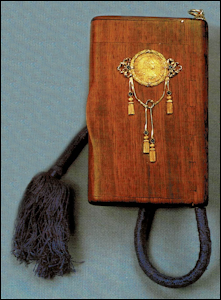
Provenance: Hodges Family Collection, Stock Number 15920
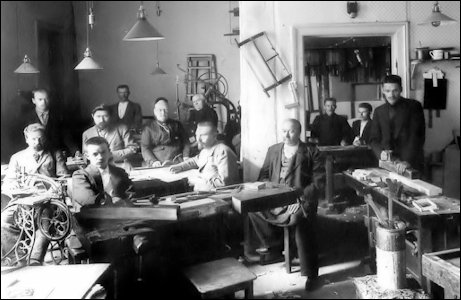
(F.) Simo and Matilda Käki Case Master Studio, Court Yard Building at the House of Fabergé Premises in St. Petersburg, Russia. Matilda is Seated Left of Center in the Middle Ground (Courtesy Fersman Mineralogical Museum, Moscow, and Ulla Tillander-Godenhielm)
Characteristics of the Hodges case (E.) signed by Hjalmar Armfelt:
- Constructed of palisander wood adorned with a gold Russian ruble depicting Empress Elizabeth Petrovna (1709-1762, reigned 1741-1762).
- A tinder cord is present, instead of laurel or chestnut leaves the coin is surrounded by gold bows and dripping gold tassels studded with cabochon sapphires.
- No gold thumb piece, but what really strikes the eye is the applied coin decoration oriented vertically rather than horizontally.
- The gold marks are for 1904-1908, which coincides with the date when Armfelt took over the Aarne’s workshop sometime in 1904.
A pleasant surprise during this research was to learn the Armfelt cigarette case has a storage/presentation case. Kieran McCarthy7 in his 2009 article states these details –
A 1902 photograph of the studio of Simo Käki (1819-1896), leading casemaker and supplier of wooden cigarette cases, photo frames, bell pushes and other items composed of wood is extant, when his widow Matilda operated his workshop. The Fabergé firm was known for its cigarette cases composed of precious metals (silver, gold, and platinum), adding antique coins, gemstones, and decorations to ordinary palisander and birch wood cases to create an elegant and luxurious, yet useful object which appealed to the crowned heads of Europe, their families and courtiers. Cigarette cases made of unadorned wood were not unknown in Russia, however, using a wooden cigarette case decorated by Fabergé appealed to those clients who had many precious metal cases and wanted a new and affordable design. Prices in the London shop started at £1 and went as high as £12 pounds depending on the added ornamentation with the average wood case costing £4.5.8
| 1 | Also known as rosewood due to its strong sweet smell lasting for many years. |
| 2 | de Guitaut, Caroline. Fabergé in the Royal Collection, 2003, p. 141. |
| 3 | Bonus, Wendy. The Fabergé Connection: A Memoir of the Bowe Family, 2010. |
| 4 | von Habsburg, Géza and Marina Lopato, Fabergé: Imperial Jeweler, 1993, pp. 124, 131 (footnotes 1-2). |
| 5 | Fabergé Smoking Accessories: Materials and Techniques of an Art Form by Christel McCanless and Timothy Adams presented at the 2016 Fabergé Symposium in Houston, Texas (Fabergé Research Newsletter, “Fabergé Smoking Accessories: Materials and Techniques of an Art Form” PowerPoint Presentation and Handout). |
| 6 | Sotheby’s London, November 30, 2009, Romanov Heirlooms: The Lost Inheritance of Grand Duchess Maria Pavlovna, featured in Fabergé: The McFerrin Collection. The Opulence Continues…, 2016, pp. 128-131. |
| 7 | Kieran McCarthy discusses “Faberge’s Work in Wood” in Keefe, John. Fabergé: The Hodges Family Collection, 2009, pp. 30-31. |
| 8 | McCarthy, Kieran. Fabergé in London: The British Branch of the Imperial Russian Goldsmith, 2017, p. 20. |
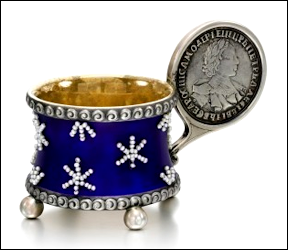

Brooch by August Hollming,
1899-1908
(McFerrin, Dorothy, From a
Snowflake to an Iceberg: The
McFerrin Collection,
2013, p. 182)
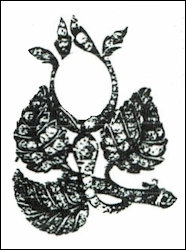
for August Fredrick Hollming or
August Wilhelm Holström (sic),
within the Fabergé Workmaster
Circles in St. Petersburg. Gold and
Silver. Skr 8,700.
(Auktionsverk, Stockholm, April 26, 1977)
Doyle New York, Russian Works of Art, April 28, 2020, includes an essay entitled Feodor Rückert by Mark Moehrke to accompany several pieces under the hammer by this Russian workmaster, who also worked for Fabergé. Both links are illustrated with the same Russian parcel-gilt silver and cloisonné enamel bowl, Feodor Rückert, Moscow, 1908-1917. Price realized $43,750.
Sotheby’s London, Russian Works of Art, June 9-17, 2020
Auction review by Andre Ruzhnikov: Sotheby’s Russian Sales June 2020 published July 10, 2020.
Sotheby’s website has a new feature highlighting Fabergé objects with these topics:
- Works by Carl Fabergé at Sotheby’s
- Carl Fabergé Biography
- Carl Fabergé Videos and Stories
- Museums with Works by Carl Fabergé
Christie’s London, Russian Art, July 1-21, 2020, with a separate listing of sale results.
Auction reviews by Andre Ruzhnikov:
Christie’s Russian Sale July 2020: Bric-a-Brac, Not Antiques! published July 15, 2020
Plates & Rückert Emerge from Christie’s Bric-A-Brac, published July 27, 2020
Christie’s London, Gloria: Property from the late Dowager Countess Bathurst, July 22, 2020 online auction, hard copy catalog was published.
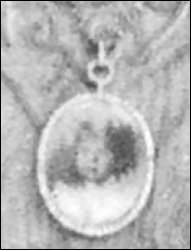
Among the collection of previously unknown surprises once hidden within Fabergé’s Imperial Easter Eggs is a locket proposed to be from the Rose Trellis Egg and was created by Fabergé workmaster Henrik Wigström. The egg, in the Walters Art Gallery (MD) was presented to Empress Alexandra Feodorovna by her husband, Emperor Nicholas II for Easter 1907. The find of an image of the locket surprise was brought to light on the concise website, Miek’s Fabergé Eggs, through the diligent research by Annemiek Wintraecken (The Netherlands), and Greg Daubney (UK).
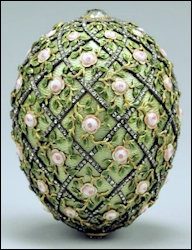
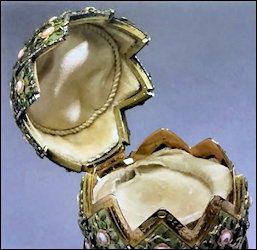
(Courtesy Annemiek Wintraecken)
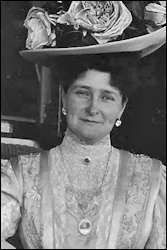
Published description of the surprise from the original Fabergé archives describes it as: “A diamond chain with medallion and miniature of H.I.H. Czarevich Alexei Nicolaievich; the portrait of the Czarevich being painted on ivory”.1
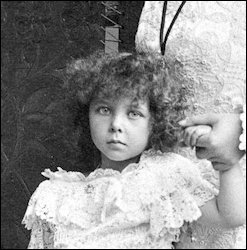
Surely, I am not alone in being frustrated by images of historic photographs which cannot be brought up to the level of clarity we would hope to use in our research. In this case, the reveal of this 1907 ‘surprise’ centers on a photograph of Alexandra Feodorovna sitting in a cushioned wicker chair on the deck of the Imperial yacht Standart. At first glance, my eye perceived the locket’s image as Alexandra’s niece, Princess Elisabeth of Hesse and by Rhine.
(Royal Collection Trust) Additional pictures
can be found in a Youtube video at
1:00 and 1:20 minutes.
Though the original Fabergé invoice clearly identifies the person to be depicted on the locket as Alexei, the ‘possibility’ exists the portrait may even have portrayed another family member. This option spawns a constellation of historical elements which enliven intrigue regardless of the final conclusion. Perhaps we might contemplate Carl Fabergé’s gift of evoking the possibilities of symbology in the making of family hallmarks each year for two unique and meaningful eggs to be presented to the Empresses, the wife (Alexandra Feodorovna) and the mother (Maria Feodorovna).
An alternative scenario for the locket, were it in fact the Empress’ niece, might be extrapolated from family history. Alexandra and her brother, Grand Duke Ernst Ludwig of Hesse (Ernie), were terribly close siblings, and even closer when his only child (at that time), Elisabeth – ‘Ella’ – died suddenly of a virulent form of typhoid on 16 November 1903, whilst on holiday with Nicholas, Alexandra, and their four daughters at the Imperial Hunting Lodge Skierniewice in Russian Poland.
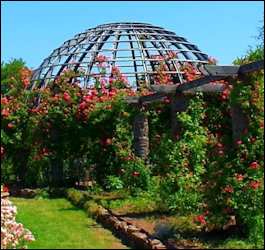
In narratives related to the 1907 Rose Trellis Egg, there is always commentary concerning Alexandra’s love for flowers. However, the motif of this egg invariably piqued my memory. In 2007, I was returning to Schloss Wolfsgarten, the former hunting seat of the ruling family of Darmstadt with its surrounding Hessian properties, and while there visited the garden park Rosenhöhe, and the grave of ‘Ella’ within its precincts.
(Photos Courtesy Annemiek Wintraecken and Wikimedia Ludwig Bickel / CC BY-SA respectively)
Were we exploring possible commemorative family events in a time frame of designing the 1907 egg, an imaginative possibility may well have been a poignant remembrance of Alexandra’s niece, as well as the painful discovery of her son Alexei ‘bleeding’ disease shortly after his birth. Such a possibility is clear in this excerpt from her correspondence with her brother, Alix to Ernst Ludwig – Tsarskoe Selo – 16/29 November 1906:
In any final consideration, the two children in question bear what might be an uncanny resemblance. ‘Uncanny’, but . . . they are first cousins.
| 1 | Fabergé, Tatiana, et al, The Fabergé Imperial Easter Eggs, 1997, p. 176. |
| 2 | Kleinpenning, Petra H., Ed. The Correspondence of the Empress Alexandra of Russia with Ernst Ludwig and Eleonore, Grand Duke and Duchess of Hesse: 1878-1916, 2010, p. 275. |
In the Exhibition section of the Fabergé Research Site information for 13 museums worldwide with permanent Fabergé exhibition is maintained. Temporary venues are noted when known. A survey to discover news from each of the permanent venues was recently conducted. Readers with additional information about new or changing exhibits are encouraged to share details, contact: Christel McCanless
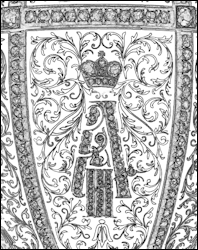
(Courtesy Hillwood Museum)
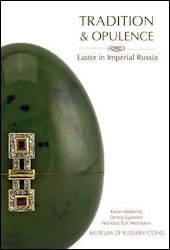
of Russian Icons, Clinton (MA)
Tradition & Opulence: Easter in
Imperial Russia Exhibition
- Houston, Texas. Houston Museum of Natural Science
Jennifer McFerrin Bohner writes: Lots is going on at the McFerrin Collection! A new exhibit, The Art of Everyday Objects in the McFerrin Gallery, is planned for April 2021-2023, and will include most major items and important pieces of provenance along with everyday objects – desk accessories, bell pushes, glasses, women’s accessories, etc. The adjoining vault area accessible to the public will feature the rest of the collection. We are always looking for new information-connections-insights about our pieces and then sharing the information with our visitors through docent training, exhibition publications, and online articles. We welcome all Fabergé enthusiasts interested in research regarding objects in the McFerrin Collection, please email us any time. We would love to work with you!
2020 Loans:- Venue at the Hillwood Museum, Washington (DC), Natural Beauties: Exquisite Works of Minerals and Gems, February 15, 2020 – January 3, 2021 (new closing date) includes four hard stone objects from the McFerrin Collection.
- Exhibition of the Museum of Russian Icons, Clinton (MA), Tradition & Opulence: Easter in Imperial Russia, April to October 25, 2020, showcases 33 pieces from the McFerrin Collection.
- Catalina Island Museum (CA), Fabergé at Sea, May 21, 2021 – Oct 21, 2021. The McFerrin Collection will loan 13 Fabergé objects connected to Imperial yachts and military cruisers. The venue moves to the Houston Museum of Natural Science, November 2021 – July 2022.
- St. Petersburg, Russia. Fabergé Museum
Visit their YouTube Channel, and also enjoy a potpourri of objects from the museum’s permanent collection. - Washington, DC. Hillwood, Estate, Museum & Gardens
Learn about Hillwood’s current, future and past exhibitions. The current venue, Natural Beauties: Exquisite Works of Minerals and Gems, February 15, 2020 – January 3, 2021.
Explore Hillwood to stay up-to-date with new videos, activities, information, and more, especially as the gardens bloom and burst with color. Weekly updates mailed to subscribers.
Temporary
(Exhibition dates change, checking in advance is advised.)
- April 7 – extended to October 25, 2020 Museum of Russian Icons, Clinton (MA)
Tradition & Opulence: Easter in Imperial Russia, an exhibition of nearly 200 objects, will recreate the splendor of Easter celebrations during the last days of the Tsars. A catalog with the same title has been published, and is illustrated above.
Online lectures: Kettering, Karen, “Decoding the Iconography and Symbols of Easter in Russian Art”
Books on the Horizon:
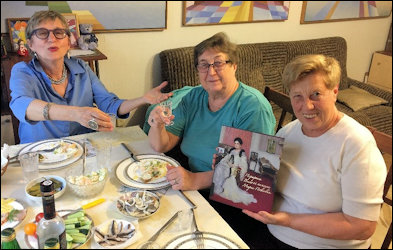
in St. Petersburg, Russia
(Photograph Courtesy Galina Korneva)
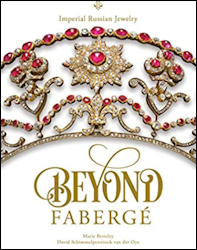
and Silversmiths to Be Unveiled in
October 2020
(Courtesy Schiffer Publishing)
Two Russian sisters, Galina Korneva (right) and Tatiana Cheboksarova (middle), have for many years studied the life and times of Grand Duke Vladimir Alexandrovich and his wife, Grand Duchess Maria Pavlovna. “The Sisters” as they are lovingly called by their research friends published an English monograph entitled, Grand Duchess Maria Pavlovna in 20141. It is a joy to share the good news that a limited Russian edition, Портреты Великой Княгини Марии Павловны. Загадки и находки (Portraits of the Grand Duchess Maria Pavlovna. Riddles and Finds) has just appeared, and we hope an English edition will soon follow. Additional book details including the excerpts below as summarized by the authors appeared in Romanov News, June 2020, pp. 78-81.
But the 20th century changed the smooth development of history. The names of Grand Duke and Grand Duchess Vladimir were mentioned only in the scientific literature during the next hundred years. It was forbidden to tell about their contributions even in the Scholar’s Club of the Russian Academy of Science, which is located in a former palace of Grand Duke and Grand Duchess Maria in St. Petersburg, at the Dvortsovaya (Palace) embankment, 26. Historians usually discuss only that the Grand Duke gave an order to fire at the peaceful demonstration of workers on 9 (22) January 1905, and that his widow Maria Pavlovna headed a family plot against Emperor Nicholas II.
The only theme discussed widely in recent years is the description of a unique jewelry collection belonging to Grand Duchess Maria Pavlovna. Interest in this collection grew after the auction (Sotheby’s London, November 30, 2009, Romanov Heirlooms: The Lost Inheritance of Grand Duchess Maria Pavlovna), in which Fabergé cigarette cases and cufflinks lost for 90 years were sold. An analysis of the paintings collected by the grand ducal family2 demonstrates the value of the paintings is as great as the jewelry. Impeccable taste, a refined eye, and the knowledge of art attributed to the owners were helpful in creating the collection. Moreover, Grand Duke Vladimir and Grand Duchess Maria alternately headed the Imperial Academy of Arts in St. Petersburg for almost half a century. This position gave them opportunity to know well the main directions and events in the world of art both in Russia and Europe. There can be no doubt that the grand-ducal family selected even more carefully the artists chosen to paint their own portraits and portraits of their children. Among them were well known Russian and foreign Masters: Konstantin Egorovich Makovsky (1839-1915), Boris Mikhailovich Kustodiyev (1878-1927), Lev Samuilovich Bakst (1866-1924), Stepan Fyedorovich Aleksandrovsky (1842-1906), Aleksander Mikhailovich Leontovsky (1865-1928), Ernst Karlovich von Lipgart (1847-1932), Baron Heinrich von Angeli (1840-1925), Francois Flameng (1856-1923), Albert Edelfelt (1854-1905), and Sophia Vladimirovna Khotyaintseva (1837-1891). Even in a circle of these famous artists, the name of French painter George Bekker (1845-1909) stands out. He painted a portrait of Grand Duchess Maria Pavlovna set in her Cabinet in their St. Petersburg Palace. The portrait has some unquestionable merits from historic, artistic, and other points of view. It is notable also for its financial value.
| 1 | Korneva G., Cheboksarova T. “Velikaya Knyaginya Maria Pavlovna”. SPb. 2014; G. Korneva, T. Cheboksarova “Grand Duchess Maria Pavlovna”. SPb. 2014. Other books in English by the authors include St. Petersburg. By the World Created — by Its Beauty Preserved (2003), Empress Maria Feodorovna’s Favorite Residences in Russia and Denmark (2006), and Russia and Europe. Dynastic Ties (2012). |
| 2 | Articles written by G. Korneva and T. Cheboksarova in Khudozhestvenny Vestnik (Art News) appeared in 2016-2018. |
The husband and wife team of Marie Betteley and David Schimmelpenninck van der Oye are excited to announce the publication of their book Beyond Fabergé: Imperial Russian Jewelry on October 28, 2020.
Learning tools:
- Lesley Andrews, a member of the Cape Town Gem & Mineral Club, published an article, “Faberge’s Birds” in the club’s newsletter, Mineral Chatter, August 2020. Thank you for sharing it.
- Thomas Holman of Wartski London is teaching readers the basics in a “Brief Introduction to Enamel”.
- The in’s and out’s of the Engine Turning/Guilloché process which incises metal with a pattern used in Faberge’s time and still today is explained by David Wood-Heath, a British engine turning machine collector who restores and uses his treasured antique models. He presented the talk at the 2016 Ornamental Turners International Symposium in Denver, Colorado. The Fabergé Research Newsletter has briefly covered this topic complete with illustrations twice (Fabergé Research Newsletter Spring 2012 and Spring and Summer 2017 editions).
- Nicholson, Nick, “Black Gold: Russian Lacquer from the 18-20th Centuries” includes five lacquer boxes with Fabergé decorations. (Courtesy Russian History Museum)
- Kettering, Karen, “A Mass of Brilliant Color: Vestments for the Coronation of Nicholas II and Alexandra Fedorovna” (Courtesy Russian History Museum)
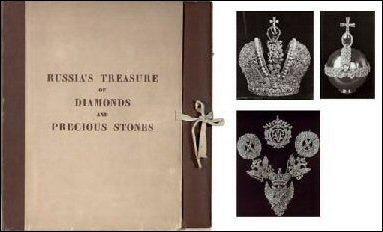
(Courtesy Christie’s)
Rosemary Tozer, Senior Research Librarian, R.T. Liddicoat Gemological Library and Information Center at the Gemological Institute of America (GIA) has been fascinated for a long time by the Fersman Portfolio, (Russia’s Treasure of Diamonds and Precious Stones, Moscow: People’s Commissariat of Finances, 1925-26). The four-part set under the leadership of the Russian mineralogist, Alexander Fersman, is one of a small number of surviving catalogs promoting the sale of Russia’s crown jewels in 1926. Thanks to digitization the set is available for your research needs without a trip to the Liddicoat Library in Carlsbad, California.
Past issues of the Fabergé Research Newsletter include articles on Faberge objects in this Russian archival treasure: Fersman Portfolio Fall 10 | Winter 10-11 | Spring 12 | Spring 13 | Winter 15 | Summer and Fall 16
Research tools and a feast for the eyes:
Are you aware with a few clicks of your mouse on the Royal Collection Trust website you can find a biographical details about Fabergé workmaster Mikhail Perkhin (born 1860-1903, active 1886-1903) and see a collage of 101 objects complete with illustrations and descriptions made by his studio, now in the collection of Queen Elizabeth II. Try it also for other Fabergé workmasters!
The dealer website of Andre Ruzhnikov is a nirvana for Fabergé researchers. At the bottom of most of his Fabergé objects there is a link to “related works” with stunning pictures, and object details – a journey worth taking! What is your favorite type of object?
- Desk Clocks
- Frames
- Parasol Handles
- Cigarette Cases
- Bell Pushes
- Compacts
- Romanov Imperial Antiques
- Just published, The Clock Collection complete with 77 illustrations.
Fabergé objects from the dealer’s website, Romanov Russia, are attractively photographed and described with myriad details.