
Newsletter 2026 Summer
- April 14-15, 2027 Exciting News! Seventh Fabergé Symposium on at the Houston Museum of Natural Science in Texas
- Fabergé Highlights on a Regent Seven Seas Cruise
- Fabergé’s 1894 Renaissance Egg and Its Revised 1937-1942 Chronology
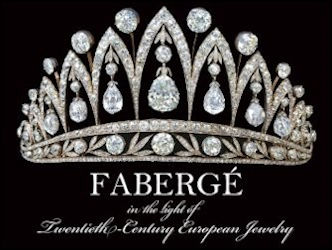
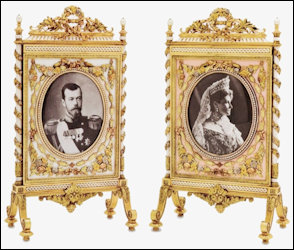
on Loan to the Houston Museum of Natural Science in Texas
(From a Snowflake to an Iceberg: The McFerrin Collection, 2013 – Tiara, pp. 184-187, and Frame, p. 134)
The staff of the Houston Museum of Natural Science and their dedicated Fabergé docents are planning a new Fabergé exhibition selected from the very comprehensive Artie and Dorothy McFerrin Collection1 with an added highlight of a Fabergé enthusiasts gathering. During the previous six Fabergé symposiums (2011-2018) exciting research discoveries were shared by Fabergé scholars, aficionados, and owners of the treasured objects:
- Richmond, Virginia Summer 11 (Special Edition) | Fall and Winter 18
- Houston, Texas Winter 12-13 | Winter 16 (Fabergé Symposiums: A Look Back and into the Future)
- St. Petersburg, Russia Fall 14 | Summer 18
For the 2027 Seventh Fabergé Symposium in Texas the speakers will be sharing their research Fabergé highlights with international connections to support the newly opened McFerrin exhibition and this symposium. Research data from other worldwide personal or museum Fabergé collections, objects known from Fabergé auctions, and from scholarly and archival publications, will be included. The first six symposiums and additional Fabergé news are described with details in the Fabergé Research Newsletter begun in April 2008 and the entire Fabergé Research Site, both available without a subscription fee.
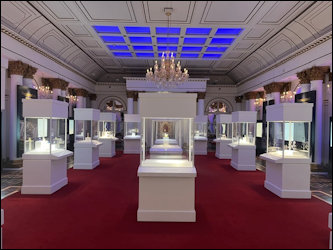
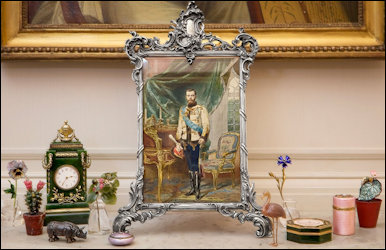
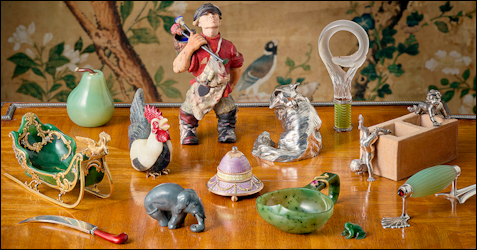
Collection on View at the Houston Museum of Natural Science in Texas.
(Photograph Courtesy Patricia Hazlett)
| 1 | McFerrin Collection Publications: From a Snowflake to an Iceberg: The McFerrin Collection, 2013 | Fabergé, The McFerrin Collection, The Opulence Continues …, 2016. Pamphlet: Everyday Fabergé: The McFerrin Collection, 2013 (PDF available to print). Video – Fabergé Eggs and Timeless Treasures, 2024. |
A Spotlight on Fabergé cruise sailing in May 2026 from Rome to London with ports of call in Spain and France was sponsored by the Regent Seven Seas Cruises. For the cruiser’s enrichment program while at sea, Dorothy McFerrin, and her daughter Jennifer McFerrin-Bohner, and Timothy Adams presented lectures about the Artie and Dorothy McFerrin Collection, and the history of the original jewelry firm led by Carl Fabergé (1846-1920), well-known jeweler for the Russian Imperial Court. The McFerrin Collection with some 600 Fabergé and Russian objects is recognized as one of the most significant private collections of its kind, and part of it is on loan to the Houston Museum of Natural Science in Texas. The exhibit, Fabergé: Eggs and Timeless Treasures in Brown Hall on the museum’s first floor curated by Joel Bartsch, President of the Houston Museum of Natural Science in Texas, can be viewed in a video presentation.
During the cruise, Jennifer McFerrin-Bohner explored the breadth and significance of the McFerrin Collection, and discussed the distinctions between conservation and restoration, as well as the challenges and responsibilities involved in stewarding a collection of such scale and importance. Dorothy McFerrin shared some of her favorite collecting stories by offering personal insights into the formation of the collection and engaging guests during lively question-and-answer sessions. Her presentations provided a unique perspective on the passion, dedication, and discoveries which have shaped the collection over the decades. In a history lecture about the Fabergé firm (in existence from 1842-1918 in St. Petersburg, and other Imperial Russian geographical locations) Timothy Adams featured the Imperial Easter Eggs, Fabergé’s workshops and workmasters, Imperial presentation and award pieces in the McFerrin Collection, and the prevalence of “Fauxbergé” objects in today’s marketplace.
Also participating in the voyage were representatives of the contemporary British Fabergé jewelry company, which continues to employ goldsmithing and enameling techniques inspired by the traditions of the original Russian Fabergé jewelry firm. The Seven Seas Grandeur cruise ship displays for its passenger a jeweled and enameled egg (connect to RF pix) to preserve the Fabergé name as a jewelry brand for several decades during which the “Fabergé” name was licensed for use across a variety of unrelated industries. Guests heard from Dr. Marcus Mohr, Managing Director of Victor Mayer, the German jewelry manufacturer responsible for producing Fabergé jewelry today, and since its 19981 involvement. His lecture and video demonstrated how contemporary Fabergé pieces are crafted using traditional jewelry methods, including hand-casting, chasing, enameling, and finishing techniques.
Together the two sets of presentations offered guests a comprehensive view of both the historical achievements of the original Fabergé firm and the ongoing revival of its artistic traditions. The voyage highlighted why the name Fabergé remains synonymous with exceptional craftsmanship, artistry, and the enduring legacy of the goldsmith’s art.
| 1 | Key Owners and Custodians of the Fabergé Name |
A new discovery in the Archives of Lytham Hall, an 18th century Georgian country house in Lancashire, England, suggests a revised ownership chronology for the 1894 Fabergé Renaissance Egg (A.) presented at Easter by Emperor Alexander III (1845-1894) to his wife, Empress Maria Feodorovna (1847-1928), just eight months before he died. The discoveries in this essay update standard Fabergé hard-copy reference books and electronic websites (B.) with more specific details for the years 1937-1942.
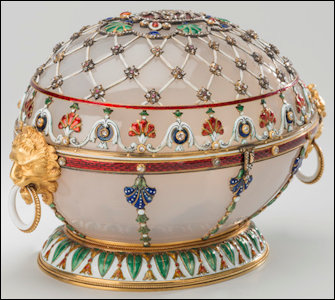
(Courtesy Fabergé Museum Collection, St. Petersburg, Russia)
- Fabergé, Tatiana, Proler, Lynette G., and Valentin V. Skurlov. The Fabergé Easter Eggs, 1997.
- Lowes, Will, and Christel Ludewig McCanless. Fabergé Eggs: A Retrospective Encyclopedia, 2001, pp. 38-42)
Websites:
- Mieks Fabergé Eggs (Website current as of 2021) Fabergé Research Site – Egg Chronology, and Fabergé Research Newsletter – Fall 13 | Fall 15 | Spring and Summer 17 | Fall and Winter 17
Henry Talbot de Vere Clifton1 Squire of Lytham (1907-1979), known as “Harry” (C.) for most of his life, inherited his title and estate at the age of 20 in 1928, and his love of collecting objets d’art commenced during a world tour in 1930. On a visit to New York City in 1934, Harry first met the industrialist and philanthropist owner of the Hammer Galleries – Armand Hammer (1898-1990). It was one of the oldest art galleries which Hammer had started in 1928. The two gentlemen became good friends to the extent that Armand Hammer became Harry’s financial agent and was granted financial power of attorney for Harry in the USA. In May 1937, the Renaissance Egg (D.) was advertised by the Hammer Galleries, New York, and shown at a Hammer exhibition (E.) in 1939.
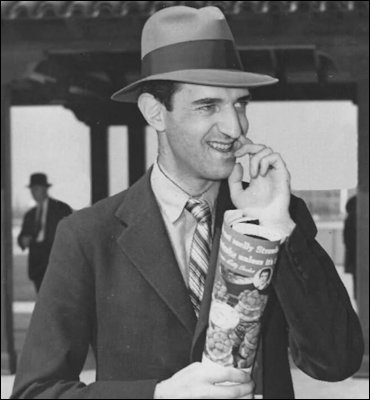
(Photograph Courtesy of Lytham Heritage Centre)
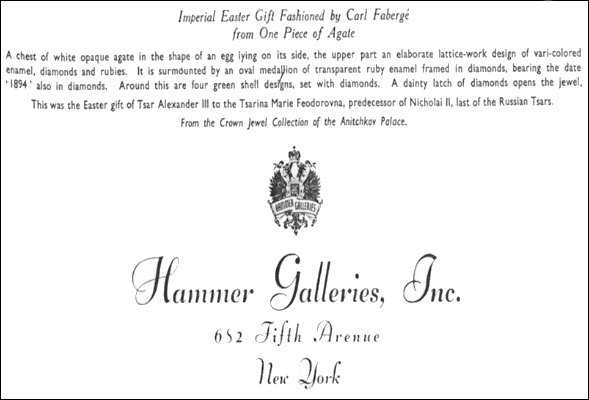
(Connoisseur, Vol. 99, No. 429, May 1937, p. 67)
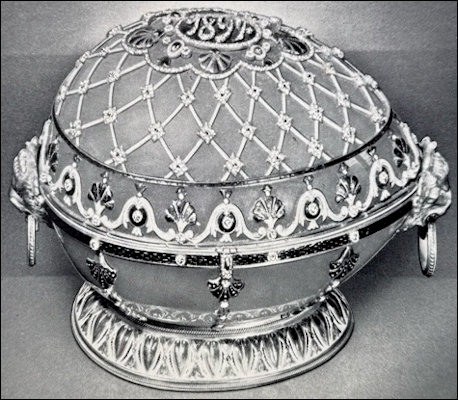
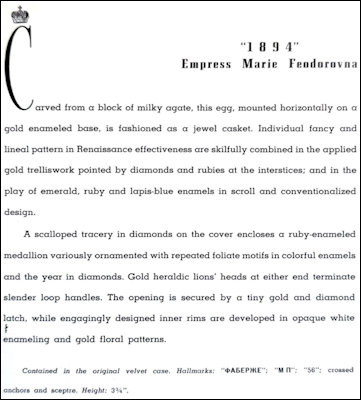
(Courtesy of Lytham Hall Archives, Lancashire, UK)
1937 In October, Harry again visited the USA, and in Boston he married the American divorcée, Lillian Lowell Griswold, and purchased the 1894 Renaissance Egg from the Hammer Galleries. In Peter Watson’s 2025 booklet2, it is interesting to note the egg was purchased “in the year they married”, and sold in September 1942 which was around the time the couple was divorcing, and Harry had financial difficulties. Archival evidence (I.) discussed at the end of this research article further confirms these details. The close association of the Fabergé Imperial Eggs with Harry Clifton’s wedding to Lillian Lowell Griswold was not limited to the 1894 Renaissance Egg. The 1895 Rosebud Egg (F. – F.1) which Harry bought in the same year as the Renaissance Egg, was famously damaged as a result of Lillian throwing the Egg at Harry, – “her action being symbolic of her hatred of being treated like part of his collection”.3
Fabergé Research Site details confirm what has been cited about the 1895 the Rosebud Egg in standard reference books and are now supplemented by the 2025 Watson publication:
- ca. 1937. Bought by Henry Talbot de Vere Clifton, millionaire landowner, sportsman, & poet (UK) 1941-42. Sold in the U.S. by Henry Talbot de Vere Clifton [Ed. Note: Harry may also have parted with the Rosebud Egg at around the time of his divorce with Lillian which was finalized in October 1943. It also appears to have coincided with the start of Harry’s financial difficulties.]
- 1962. Whereabouts unknown
- August 15, 1985. Fine Art Society, London, negotiated sale to the Forbes Magazine Fabergé Collection in New York for $525,000.
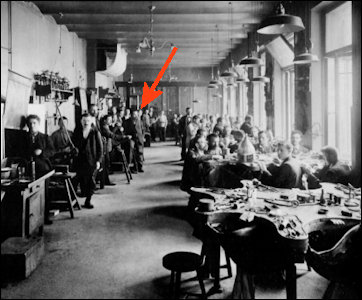
manufacture of the 1894 Renaissance Egg and the 1895 Rosebud Egg.
Before moving to 24 Bolshaya Morskaya Street in 1900.
(Tillander-Godenhielm, Ulla. Fabergé: His
Masters and Artisans, 2018, pp. 72-73)
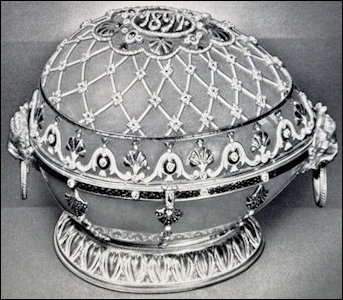
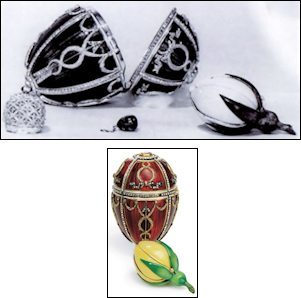
Surprises of the 1895 Fabergé Rosebud Egg Have Been
Identified”, by Chad Solon Fabergé Research
Newsletter, Winter 2021)
The 1895 Rosebud Egg which Harry bought in the same year as
the Renaissance Egg, was famously damaged as a result of
Lillian Lowell Griswold throwing the Egg at Harry, – “her
action being symbolic of her hatred of being treated like
part of his collection”.
(Watson, Peter D., Op. cit., p. 21)
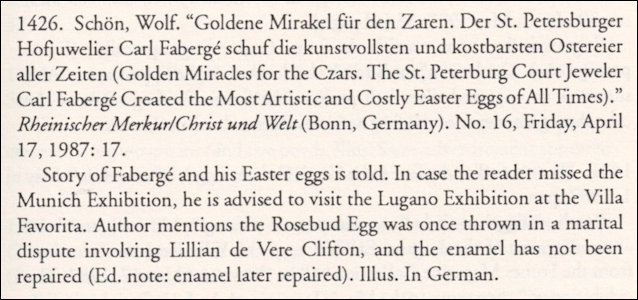
(McCanless, Christel Ludewig. Fabergé and His Works: An AnnotatedBibliography of the First Century of His Art, 1994, p. 291, #1426)
1938 “Harry T. Clifton” had returned to England, while the Renaissance Egg remained in the USA in the care of the Hammer Galleries, and it was included in a 1939 exhibition tour along with 19 other Imperial eggs hosted by Hammer Galleries and displayed in New York and Palm Beach, Florida.
1942 Following the outbreak of World War, II Harry decided to ship most of his art collection now totaling over 500 items from England to the USA. A risky venture across the Atlantic Ocean during a world war. It was with the consent and encouragement of the Ministry of Economic Welfare and intended to help Britain’s currency. Harry’s estate manager, William Latham traveled from the UK in March 1942 to manage the sale in the USA.4 The September 19, 1942, copy of the financial summary statement (I.) found in the Archives at Lytham Hall confirms the sale of the Renaissance Egg from Henry Talbot de Vere Clifton to Jack Linsky, owner of the stapler fortune, in New York.
1942 – 1943 The “Harry Talbot Clifton Collection” which included the Renaissance Egg was advertised for sale at Parish Watson & Co. on 44 East 57th Street, New York art dealers, where the vast collection was sold to a variety of dealers and collectors. Is it possible a financial summary statement for the 1895 Rosebud Egg, also once owned by Harry Clifton, is the in archives of the Parish Watson & Co., New York, or in the Forbes Magazine Fabergé Collections archives in St. Petersburg, Russia?
2025 The discovery in the Lytham Hall Archives, Lancashire (UK) suggests the timeline of the Fabergé egg sale is five years earlier than cited in the reference publications (B.), and it reveals the purchase price of the Renaissance egg (I.) to be $2,000.
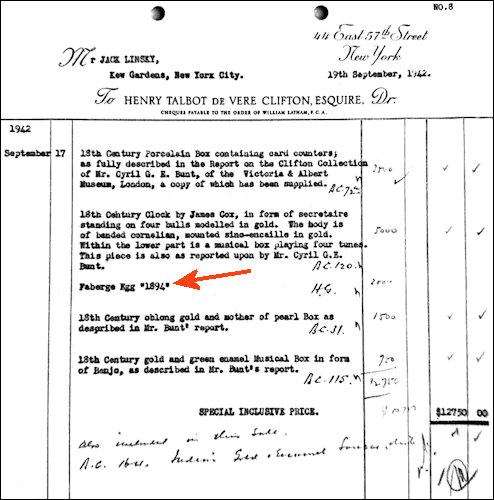
Kew Gardens, New York, for six items including the Fabergé Egg ‘1894’.
The H.G. annotation indicates the egg (item 3) was deposited with the
Hammer Galleries at the time of the sale to “Harry Clifton” with his given name.
(Courtesy of Lytham Hall Archives, Lancashire, UK)
A closer look at Hammer catalogs by Anna and Vincent Palmade (USA) in 2026:
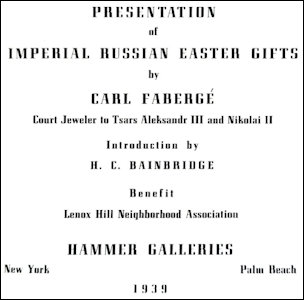
(Lytham Hall Archives, UK)
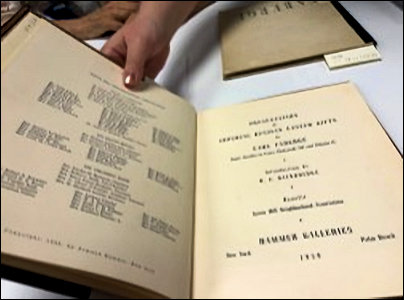
(Freeman Library, Virginia Museum of Fine Arts (USA))
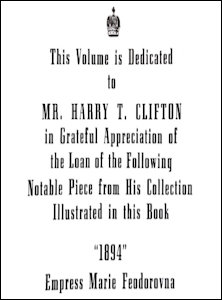
Feodorovna
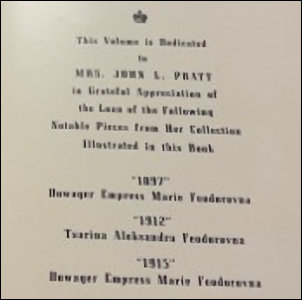
“1897” Dowager Empress Marie Feodorovna …
(Pelican Egg, mistakenly attributed to 1897
because of the 1797-1897 inscription on it)
“1912” Tsarina Alexsandra Feodorovna
(Tsarevich Egg)
“1915” Dowager Empress Marie Feodorovna
(Red Cross Portraits Egg)
A numbered Fabergé copy of a 1939 Hammer Exhibition Catalog lists the 19 (nineteen) Imperial Russian Easter Gifts by Carl Fabergé attributed to either the Dowager Empress Marie Feodorovna, or to Empress Alexandra Feodorovna. More recent research suggests eight of the 19 eggs were not Imperial. These eight non-imperial Fabergé Eggs are six “Kelch Eggs” (out of seven), the “Nobel Egg”, and the “Crown Egg”. The historical website, Mieks Fabergé Eggs, is an excellent reference tool for further historical studies of Fabergé eggs.
Christel Ludewig McCanless recalled art historian Karen Kettering’s intense study of Hammer exhibition catalogs located in major American libraries and she then presented her findings at the Russian History Museum, Jordanville, New York.5 Dr. Kettering shared her observations with the author of this article and the peer review team. In closing, she suggested “it is very likely that different catalog copies were made to be presented to important lenders – a common practice in the gallery-dealer world.” And a final thought she adds – “I have seen 1939 catalogs from Hammer belonging to two different American collectors. They are strikingly different and share only about 25% of their content!”
During 2026 visits in a variety of American scholarly art libraries, Fabergé enthusiasts and librarians compared the 1939 Hammer catalogs in the Hillwood Museum Library, in two personal Hammer catalog collections located in Washington (DC), and the Freeman Library at the Virginia Museum of Fine Arts in Richmond (VA). A pictorial match (G. – H.) was found to the illustrations. However, the findings leave no doubt the dedication page with different data does not match identical exhibition catalogs.
Another long-time Fabergé researcher recalled the Hammer Galleries used as part of its active merchandising effort folded card board sleeves into which assorted postcards of Fabergé objects with photographs and descriptions were inserted. The Hammer Galleries staff swapped out cards as new merchandise was added, or existing objects had not sold, and then used them at the next stop on the selling tour. And after all these years, they are now even more out of order as xerox copies of the library holdings been made by researchers and the library staffs over the years, and unfortunately, the original postcards were not always returned to the original sleeves.
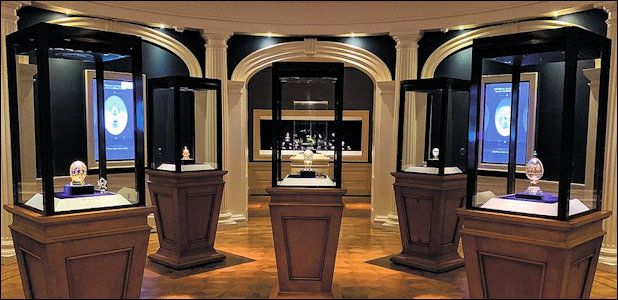
(Kester, Rachel. Magnificent Obsession How One Woman’s Love of Russian Art Gave Richmond Exclusive Masterpieces, Richmond Magazine, July 3, 2023)
The Renaissance Egg on the Fabergé Research Site discusses another interesting bit of research – a possible model for this 1894 original Fabergé egg.
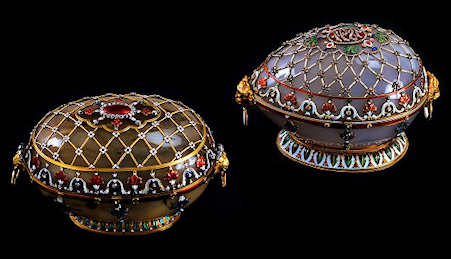
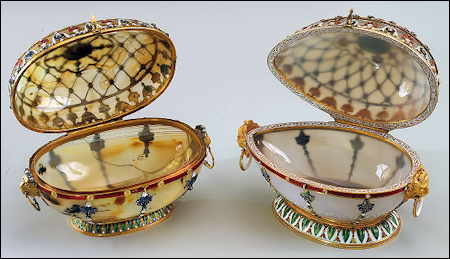
(Fabergé Museum, St. Petersburg, Russia)
(LEFT PICTURE: Photograph © Géza von Habsburg | RIGHT PICTURE: Courtesy Green Vault, Dresden, Germany)
A big Thank You to Lytham Hall participants – Carol Howarth, the Archives staff, and to the authors of the Lytham Hall books, Karen Kettering, Anna and Vincent Palmade as well as the staffs at the Hillwood Library in Washington (DC), and the Freeman Library, Virginia Museum of Fine Arts in Richmond (VA), who helped immensely to make this detailed study possible.
| 1 | Henry Talbot de Vere Clifton, Squire of Lytham (1907-1979). Kennedy, John. The Clifton Chronicle, 1990. Watson, Peter D. Harry Clifton Squire of Lytham–The Extraordinary Life of an English Eccentric, Expanded Second Edition, 2025. (Booklet of 48 pages). Slattery-Christy, David. “Harry Clifton: The Life of the Last Squire of Lytham”, Lancashire Life, February 14, 2024. |
| 2 | Watson, Peter D. Harry Clifton Squire of Lytham – The Extraordinary Life of an English Eccentric, 2025, p. 21. |
| 3 | Ibid., p. 21. |
| 4 | Kennedy, John. The Clifton Chronicle, 1990, p. 262. |
| 5 | Kettering, Karen, “Afterlife of Fabergé: Fauxbergé and More”, 2022. |
Dmitry Krivoshey (St. Petersburg, Russia) shared “11 very important book titles in Russian” which he translated and annotated into English with their publication data and a content summary. The data for these books has been added with the designation (*Russian) after each entry in the chronological Selected Fabergé Bibliography on the Fabergé Research Site which covers these years –
Together with the lead story from the Fabergé Research Newsletter, Spring 2026 – Russian Fabergé Research Publications (50 Page Bibliographic Guide) from the Krasnodar Regional Universal Library A.S. Pushkin Scientific Library entitled, Carl Fabergé Recommended Bibliographic Guide (2021), an amazing number of new research tools are available for historical research. The Krasnodar guide includes a Table of Contents and a Compiler Summary for the voluminous book and journal publications listed, and can be translated with Google Translation. Special thanks to our thoughtful newsletter contributor!
A helpful hint! For research in this modern electronic world the use of World Catalog, a free resource which allows you to “Browse 10,000+ Libraries” world-wide to find a location for your resource. Most libraries offer interlibrary loan service – possibly with a fee.
The fascinating discovery about a Fabergé Egyptian Style object by Andre Ruzhnikov appeared on his website, “Fabergé on the Nile & the Amazing Story of Walter Winans”, April 21, 2026.
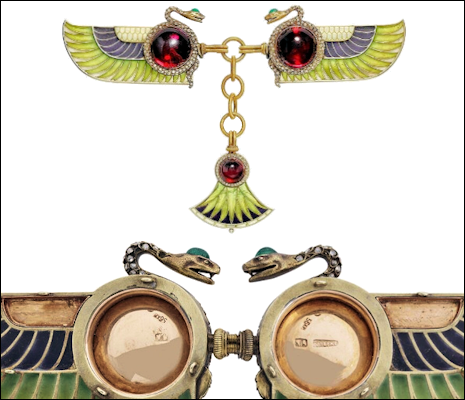
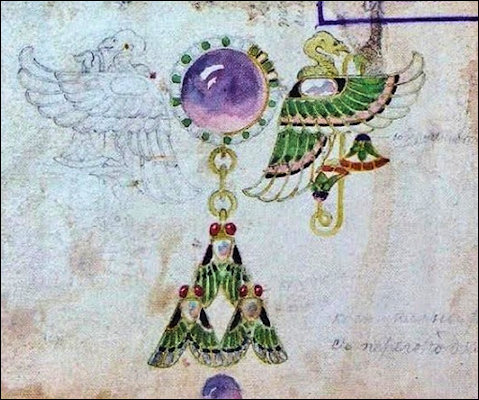
Armfelt – mark ЯА
 – active 1904-1917, and was purchased for £75 10s by Walter Winans (1852-1920) from Fabergé’s store at 48 Dover Street on 13 April 1908.
(Courtesy Andre Ruzhnikov Website Article, UK)
“In 1934, a New York Collector Bought a Fabergé Figure Tied to Russia’s Imperial Court; Nearly 80 Years Later It Resurfaced in a Family Attic and Sold at Auction for a Record $5.2 Million”, The Times of India, September 23, 2026.
Paul Gilbert compiled “… a comprehensive list of more than 125 English language books written about the life and reign of Emperor Nicholas II. (November 9, 2024)” A free 2026 updated version is now available.
Museum Treats:
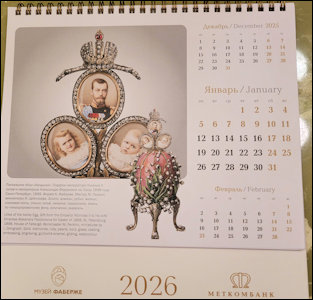
Free-standing Calendar with the 1898 Lillies of the Valley Fabergé
Egg and Other Objects with Russian & English Object Descriptions
(Gift from Faberge Enthusiasts)
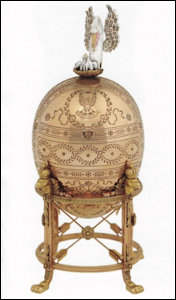
Thomas Pratt Collection Donated
on July 21, 1947 to the Virginia
of Museum of Fine Arts was
Illustrated in the Artmobile
Feature of the VMFA
Summer 2026 Issue, p. 13.)
Youtube
The British Antiques Trade Gazette, the newspaper “read by all serious buyers and sellers of art and antiques” has a variety of articles with Fabergé news in it. A member of the ATG subscription team advised: “If you sign up for a £4 trial you will have unrestricted access to our archived content, including any of the 47 articles you wish to view for your research. You can of course print or cite any of these articles for your personal use, but you may not distribute them.” Happy hunting to fellow Fabergé researchers! Our thanks to James Brewer of ATG for his kind assistance!
A summary of comments and questions received from newsletter readers during the required software revision process for the Fabergé Research Site and the updating (when possible!) of the links for 18 years of the Fabergé Research Newsletter publication, is attempted here. Special thanks to Anna and Vincent Palmade, and Riana Benko, who contributed additional details.
“Once again, I greatly appreciate your site. In my opinion, it is the best Fabergé resource available online, rivaled only by books.”
“… thank you for curating such an incredible website. I have been scouring it, and have learned so much! Thank you for your commitment to history, and your dedication to upholding Faberge’s standards of excellence. Your achievements, contributions, and academic impact speak to your passion, and I appreciate your expertise.”
And several inqueries from researchers dedicated to finding a trail for two missing eggs, and other interesting original Fabergé objects.
(1.) Question: How does one tell if an object was made by the Rückert (Rueckert) workshop and only sold by Fabergé?
Brief answer: Rückert was an independent firm, most of their business was done under their own name. Fabergé ordered objects from them to sell through their retail outlet in Moscow. In such a case, there should be the addition of a Fabergé mark and the box it was sold in should also be marked Fabergé.
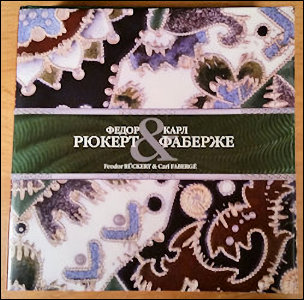
and Feodor Rückert: Master of Russian Enamel, stands as the definitive academic
catalog on his life, workshop marks, and his collaborative relationship with Fabergé.
It is a 2016 encyclopedic publication of 611 pages for the Maxim Revyakin Collection
of Old-Russian Style Objects and was published in Moscow.
(Fabergé Research Newsletter, Fall and Winter 2017)
Google search: Feodor Rückert was a brilliant master silversmith who operated an independent workshop, rather than being an exclusive employee of the House of Fabergé. [Foot note credits: 1 Via Subscription, 2 Doyle Auctioneers]1
Key Take-aways from the Google Text:
- Independent Operation: Rückert ran his own successful firm and produced the vast majority of his famous cloisonné and plique-à-jour enamel pieces under his own hallmark (Ф.Р. or F.R.). [1 Fabergé Research Newsletter, 2 Wikipedia, 3 Sotheby’s]
- The Fabergé Partnership: Fabergé recognized Rückert’s superior skill and regularly retail-purchased or commissioned objects from him to supply its Moscow branch. [1 Doyle Auctioneers, 2 Via Subscription] Both the St. Petersburg and London branches should be included.2
- Dual Hallmarking: When Fabergé sold a Rückert piece, the object typically received the Fabergé imperial warrant stamp (К.Фаберже with the double-headed eagle) alongside Rückert’s original workshop mark. [1 Fabergé Research Newsletter]
- The Complete Package: To be authenticated as a Fabergé-retailed piece, the item ideally features both makers’ marks and rests in an original, silk-lined Fabergé presentation box.
(2.) Historical Websites as Reference Tools for Original Fabergé Eggs
- Miek’s Fabergé Eggs with data gathered from 2004-2021 in English and Dutch by the late Annemiek Wintraecken in the Netherlands. The website lists in detail the various Fabergé egg categories including the 50 original Imperial Eggs known in 2021. The historical website in its status quo with historical facts is excellent, but unfortunately it has not been updated with new finds nor have recent software and link updates been implemented.
- The comprehensive original Fabergé Imperial Egg Chronology on the Fabergé Research Site begun by Christel Ludewig McCanless in January 2008 is current. Software updates in progress at press time.
- Wikipedia summaries: The total number of Fabergé Imperial eggs commissioned for the Russian Emperor Alexander III (10 eggs) and Emperor Nicholas II (40 eggs) as Easter gifts for Alexander’s wife and Nicholas’s mother, Empress Maria Feodorovna, and Nicholas’s wife Alexandra Feodorovna) are cited as 50 in some Google citations, but other sources incorrectly state the totals are 65 or 69.3
- A Word of Caution! An Artificial Intelligence answer (B.) shows modern Fabergé eggs and original ones in the same article without any distinctions explained.
- Wiki’s free encyclopedia article entitled Fabergé Egg needs a review and an update – for example, the Winter Egg recently sold (December 2, 2026) for $30.2 million does not have an illustration, more corrections need to be implemented, and blanks filled in. Date on the last update appears to be the calendar date for the day when one finds the website during an Internet search without any apparent updating for some time before then. Is the individual who has kept this website alive for a long time known to the readers? Please advise, so the historical research can be updated by the website owner, and align with other Fabergé historical websites for future consistent research for original Fabergé eggs.
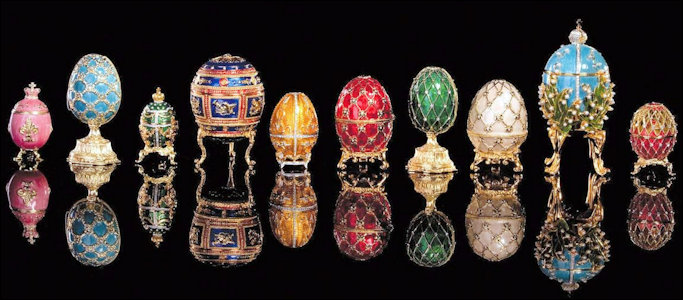
silver, jewels, and enamel. So, what is so interesting about these famous Easter eggs? Keep reading for 10 egg-quisite facts about Fabergé Eggs,
and you might join the world’s greatest easter egg hunt.“ After the illustration of the modern eggs above and the
introductory text, five original Fabergé eggs (B.) are illustrated and discussed in the text.
(Ed. Note: No explanation of the differences are stated!)
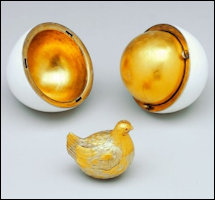
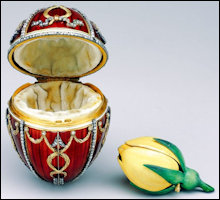
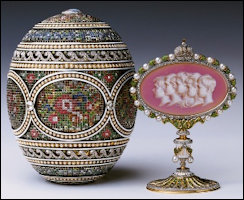
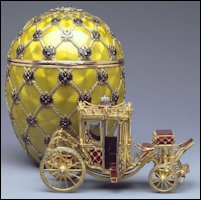
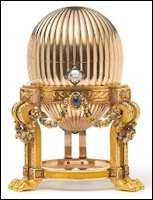
(Fabergé Imperial Egg Chronology)
(3.) In May 2017, when Helen Culver Smith was the Russian Art Specialist at Christie’s London auction house, she wrote an article with stunning auction photographs entitled, “Collecting Guide: 15 Things You Need to Know about Fabergé”.4 This catchy title has been used successfully for Fabergé objects on the Internet all these years, and a recent check yielded a large variety of results for original and modern Fabergé objects with this title. Christie’s still uses this headline with substantial Fabergé auctions, but unfortunately the older versions are not always retained.
- A bit of confusion on a Chinese blog (2023-12-12 02:09:54) using the Christie’s title, “Collecting Guide: 15 Things You Need to Know about Fabergé | Christie’s” and an illustration (C. left illustration) shows five gray matching suitcases without a caption and adopts a large amount of the Christie’s Collecting Guide text without any Fabergé illustrations, and adds a series of unrelated pendant necklace birthstone charms.
- Christie’s New York, June 10, 2026, Stream Family Collection auction published the colored auction lot advertisement (D.) on May 28, 2026, with the title, 10 Things to Know about Fabergé. The November 3, 2025, object summary edition (E.) for Christie’s London, Fabergé Winter Egg sale, December 2, 2025, is no longer on the Internet. Links to these advertisements are not maintained for future viewing, but are re-used with the generic link for other auctions.
- Sotheby’s in an article dated May 23, 2018, features Fabergé objects for their auction of Russian Works of Art, Fabergé & Icons, 5 June 2018, London: Fabergé: 7 Things You Need to Know | Russian Art
- The Victoria and Albert Museum in London for the in 2021-2022 Fabergé exhibition published the article below, and the website now states, “last updated on 17 April 2024”: Seven Things You Might Not Know about Fabergé
- The British Arts Society (April 19, 2019) features original Fabergé eggs and recommends museums to visit with permanent Fabergé collections on display: Five Fascinating Facts About Fabergé Eggs.
- Two blogs (F. – G.) – The British website, Jewellery Discovery, highlights eight original Fabergé eggs and ends with a modern pearl egg (F.) made in the year 2015. A similar pearl egg is on the Regent Seven Seas cruise (G.).
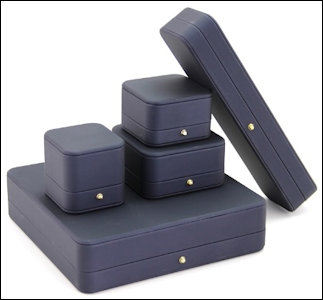
dated December 12, 2023.
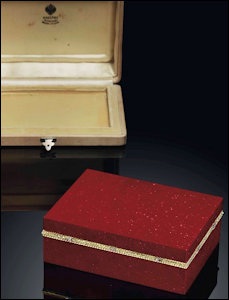
Guide …” include Imperial Fabergé eggs, a
tiara and a purpurine box from the Henrik
Wigström workshop with stock number 24687
(above), and the owner’s detail sold from
Christie’s London, June 3, 2013, for $481,875.
(Hard Copy of the Smith Article, Courtesy
McCanless Fabergé Archives)
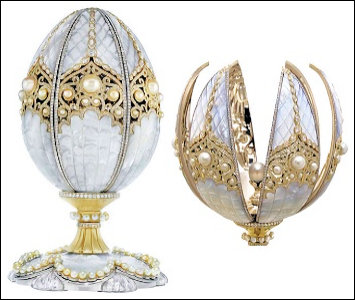
most renowned collectors of pearls, to create a truly exquisite egg
in the style of the famous Imperial Eggs.
(Nine Facts About Fabergé Eggs)
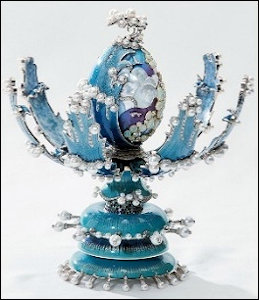
Fabergé ushered in a new era for the art of luxury
when they introduced the only Fabergé egg to set
sail as a permanent exhibit at sea.
(For more details, see Fabergé Research Newsletter
article in this issue, Fabergé Highlights on a
Regent Seven Seas Cruise by Timothy Adams (USA))
(4.) Paul Gilbert on his website (August 5, 2026), announced “A Monument to the Famous Fabergé Jeweller Mikhail Perkhin Unveiled in Karelia” complete with a lengthy biographical sketch for the Fabergé workmaster who was the third and last senior workmaster responsible for most of the Tsar Imperial Easter eggs for the years 1904-1917.
(5.) M.S. Rau, jeweler in New Orleans begun 1912 as a family business in the French Quarters, has specialized on Fabergé walking sticks, umbrella handles, and other such utilitarian Fabergé objects, while maintaining a weekly advertisement of objects in the hard-copy Wall Street Journal (WSJ), has a new website. Fabergé is no longer listed as one of their major artists they represent in their Artists Index, and Fabergé objects do not appear very much anymore in the daily edition of the hard copy and electronic of the daily Wall Street Journal.
- W.A. Bolin, a historic, family-owned jewelry house founded in St. Petersburg, Russia in 1791, later relocating to Stockholm, Sweden, after the Russian Revolution. They served as court jewelers to Russian tsars and Swedish royalty is closing by December 31, 2026.
| 1 | Internet resource links |
| 2 | Courtesy Anna and Vincent Palmade (USA). |
| 3 | Endlessly repeated on the Internet are the total Faberge eggs made with these total numbers – 61, 65, and 69. For example, “The House of Fabergé originally created 69 jeweled Easter eggs between 1885 and 1917. Today, 61 of these original eggs are known to survive.” These numbers are not Imperial Fabergé eggs of which according to extensive research only 50 were made. The historical websites (#2 above) cite the 50 Imperial Fabergé eggs which is the correct number. |
| 4 | Link no longer on the Internet, hard copy in the McCanless Fabergé Archives. |